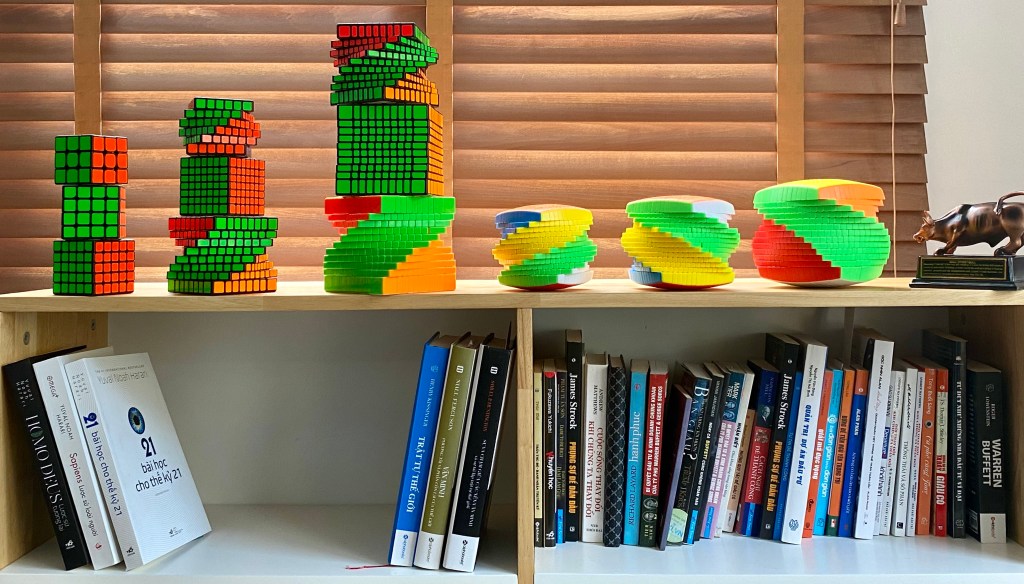
Maths attract smart people. These people can easily switch & learn other subjects as well. In life, their work is successful.
What seems to be wrong? They must have some defects, right?
Taking a closer look, you will see that mathematical thinking is divided into 3 different categories:
1. Logical reasoning
2. Learning and ability to accept new thoughts
3. Imagination
People with good mathematical ability possess high logic, quick inference, strong arguments, and others can’t refute. With that, they can draw interesting and clear conclusions, gaining admiration from others.
The next category is the ability to learn, to accept new thoughts. People in this category may not seem to know how to solve a problem, or may do it slowly, but they have the ability to understand the solution to that problem. Obviously, those with high logic can easily understand all explanations. But is that really true?
In fact, when there is not enough information, strong logic easily leads to incorrect conclusions. And when the information changes, it can lead to a worse outcome. If these people personally spend their effort solving a problem, it may not always be easy for them to receive other approaches to solving the same problem.
Especially, if these approaches come from those with lower logic than them.
In contrast, these people, who are considered slower thinkers, don’t immediately jump into solving the problem that maybe beyond their ability. They know how to balance between input data and logical inference. They know their own strength. They continue dissecting the problem and working towards a solution. Meanwhile, the solution can come from better people. This way of working helps them choose & solve their own problems.
In fact, life always presents a lot of new problems that cannot be done alone. Need to work group, it’s not easy with high logic people. Furthermore, understanding the solutions of existing problems requires much time and the ability to learn.
Therefore, do not assume that slow thinking is bad. In fact, people hire better people to work for them. That’s why there are people who start behind but can surpass those ahead.
The third category is imaginative mathematics. Having excellent logical thinking & understanding perfectly various solutions are not enough to comprehend the essence of the problem. Being at the high level of mathematics is like being an exceptional composer or a extraordinary artist. It is the intersection of intellect.
Winter 1982, 40 years ago. At the time, I was a freshmen math student at Minsk University (former Soviet Union). When taking the Topology exam, my answers were almost correct, even in the extra questions. But I got only a good score (4/5 on the scale of the former Soviet Union), not excellent (5/5). After 32 years, summer 2014, back to visit University professors. We still recognize each other, because 3 years after that exam, in the winter of 1985, this professor had guided me to participate in the Maths competition in the Vinius, the capital of Lithuania today. After chatting with him, I realised what he meant.
“You answered all the questions correctly according to the answer sheet. The whole additional question. But I know, you don’t understand the essence of the answer you said. You are just a good student, not excellent at this Topology. Imagination must be discovered by yourself, but at that time, even if I explained it, you will not be able to understand it.”
Even without his conversation, I also know my abilities. In high school, there were 30 students in the class, divided into 2 groups. Group 1 consists of 9-10 students, selected from the best math students in the class, receiving advanced training. I am part of the rest of the majority. Sometimes, I peeked at the problem questions from Group 1, but can only solve 70-80% of it. The rest I give up.
Before posting this, have asked someone in the Math Association for a comment. He said.
– You’re not excellent enough to pursue a career in Mathematics. Writing like this is like “looking down” on us intelligent types?
No, no! I’m also intelligent too, why would I mock myself? But I feel like these types of intelligence is given to us by nature rather than learned. Reasoning, learning and imagination are all gifted to us at birth. Logical reasoning and the ability to learn and understand the essence of the problem can be taught and trained, but only to a limited extent. Take for example a Rubic 3×3 spinning contest I participated. My personal record is 2 minutes and 15 seconds, while the top 3 finish at 15, 19, and 25 seconds respectively. The gap in logical thinking is apparent.
Imagination is difficult to improve if not impossible. When you see a group of children playing games or saying silly things to dolls, please encourage them (to a certain extent). The older the age, the lower the ability to imagine and the likelihood of not taking it seriously.
It’s so sad to read…
If I’m not blessed with a prodigal mind, having poor reasoning, perception and imagination, what can I do?
Intelligence luckily is not the determining factor in life. IQ, EQ and even knowledge are all assets, but innovation however is power. Therefore, forward thinking is the key. Follow those that are better than you and learn from them or even hire them to work for you…
Exceptional people, outstanding people solve world problems.
The rest of us focus on our own individual issues.
Strong societies are sustained by individuals who know their capabilities and solve problems they can solve.
OQ Theory – Quotient Orientation, Thinking Forward …
https://haimic.com/2021/05/13/iq-va-eq/
…
Ending with a rumor about Henry Ford, the owner of the Ford car company. He was often criticized by the media for not being fully educated and having advanced degrees. One time, he decided to invite scientists to a press conference to answer all the issues they were interested in. The questions: “What would happen if the speed of light was reduced by 1/2? How long will there be enough fossils fuel on earth? How do you judge artist Picasso or the composer Chopin? Where will the world go in 100 years?”
After receiving the questions. He calls out to his advisors and asked them to answer the questions to the crowd, so that he can focus on his own pressing issues.
Mr. Ford famously said: Nothing is too difficult, if you know how to break it down into small tasks.
 HaiMIC
Bình luận về bài viết này